

DEI
Welcome! In an effort to highlight and further disseminate the important work being done within and beyond WPA and its members, the WPA DEI committee will put forth quarterly updates including member spotlights, new research, resources, and more. If you are interested in sharing something with the committee to be highlighted here, please contact [email protected]
September 2025
|
Thank you for reading the WPA DEI blog! With so many things happening in the area of DEI including the erosion of legal protections for some marginalized groups, rollback of access to services for others, and erasure of diversity in multiple spheres, continuing to uphold core values of our profession—uplifting human rights, dignity, and autonomy—is very challenging right now. We see and feel the effects of marginalization in our work across all the settings where we function in our professional practice.
|
APA Policy Statement on the Benefits of Inclusivity to Psychology and Higher Education
- Enhancing inclusion, this statement encourages the reconciliation of traditional wisdom with psychological science to move toward culturally-relevant understandings of well-being.
Policy Statement on Reconciling Traditional Wisdom and Psychological Science
- Enhancing inclusion, this statement encourages the reconciliation of traditional wisdom with psychological science to move toward culturally-relevant understandings of well-being.
Maternal Mental Health Resolution on Racially Minoritized Women
- Racially minoritized women experience higher rates of maternal mortality and morbidity, and this resolution urges psychologists to collect and use intersectional data to understand and improve health and mental health outcomes.
Guidelines for Psychology’s Role in Pediatric to Adult Health Care Transition
- This document articulates best practices for supporting youth with chronic health conditions as they transition within the health care system.
Resolution on Psychological Needs of Children Exposed to Disasters
- This resolution calls for a national strategy to prevent and treat psychological consequences of children’s exposure to disasters.
Resolution on Ageism
- Addressing the impacts of ageism, this document calls for systemic change to promote inclusion and dignity for all people across the lifespan.
Policy Statement on Disability Inclusion: Combating the Stigma and Discrimination of Ableism
- This policy statement outlines the necessity of using psychological science to benefit all, including the promotion of full participation in society for every person.
June 2025
Important Announcements
|
Juneteenth
|
June 2025 marks the 5th year of the celebration of Juneteenth as an official federal holiday. Although Wisconsin officially recognized Juneteenth as a holiday in 2009, it is one of 23 states that does not provide a paid holiday for state employees. Recognition of the holiday took place all over the state. Milwaukee’s celebration has taken place annually since 1972, making it one of the oldest celebrations in the country. This year, the event included a parade on North King Drive along with music, food, and performances, as well as a special celebration during the first day of Summerfest. Celebrations also took place in Madison, Green Bay, Kenosha, Stevens Point, and many other cities. |
Pride Month
|
June also marks the celebration of Pride Month and the 10th anniversary of the Supreme Court Obergefell v Hodges decision to legalize same-sex marriage across the country. APA has multiple resources available to promote clinical competence related to sexual orientation and gender diversity available here. |
History of the DEI Committee
|
At the recent WPA convention, I began talking with several colleagues about the overall history of WPA and how things evolved to where we are today. I am relatively new to the overall organization, having only been involved for about 6 years, but I have always had an interest in understanding the history and context behind how particular traditions or processes have evolved to where we are today. So for our next update, I wanted to provide some background on the brief history of this committee. (For more information about the history of WPA, please reference Psychology in Wisconsin: The first 100 years and the Wisconsin Psychological Association’s first 50 years, published in 2019, compiled by Byron Barrington, Ph.D.) The DEI committee was developed fairly recently, but the history of this committee is valuable in understanding where WPA overall is today. The presence of a formal committee helps to ensure that there is representation of these principals in things like ongoing programming and the conference, as well as having processes in place to discuss ongoing policies and procedures. The annual award has been an important initiative in developing more opportunities for recognition of the strengths of Wisconsin psychologists and the important work being done to support historically oppressed or marginalized communities. |
Some Important Milestones for the Committee
|
|
|
March 2025
Policy Changes
|
The inauguration of Donald Trump on January 20th, 2025 has brought several swift and far-reaching policy implications for our work as psychologists. In an effort to keep Wisconsin psychologists informed about recent policy changes and to provide psychologists an opportunity to engage in advocacy, we have compiled a list of resources below: AT THE FEDERAL LEVEL o In February 2025, the APA Council of Representatives approved a policy statement by APA and affirmed psychologists’ ethical obligation to address systemic injustices and engage in advocacy focused on human welfare. o This link takes you to the APA Advocacy website where you can find information about public policy and avenues to get involved in organizing related to key issues affecting the field the psychology. o This website provides updates on recent policy and proposed policy changes to help you stay informed and also learn how you can take action. o This link provides updates on recent executive orders and includes APA’s response regarding the biological sex, sexual orientation, and gender-diversity-related executive orders. o Visit this website to tell APA how recent Executive Orders have affected you or your community in doing important work in the field of psychology. This can be related to practice, research, advocacy, consultation, etc. o Educating the public regarding key issues that affect mental health, access to services, and groundbreaking research can be pivotal. Visit this website to join the APA Media Referral Service if you have an area of expertise that you would be willing to discuss with a media outlet. AT THE STATE LEVEL: o This year’s theme is Psychology and Health Equity: Addressing disparities and improving access for all. Attend this year’s convention to learn more about how local psychologists are improving access to care and addressing systemic inequities. o The Advocacy Cabinet’s primary role is to serve as WPA’s interface with the state government and register input or positions related to topics or issues that arise that may be relevant to the profession of psychology or is in line with psychologists’ ethical imperative to engage in advocacy related to human welfare.
|
JANUARY 2025
Calendar for January-February 2025: Religious and Cultural Holidays
|
|
Recognizing religious and cultural holidays helps create an inclusive environment in organizations, schools, institutions, and communities. Therefore, we are providing a list of religious and cultural holidays, and hope this list ignites your interest in learning more about various religious celebrations. This is not an exhaustive list. |

|
January 6: January 7: January 13: Sikh: Lohri January 14: Hindu: Pongal; Buddhist: Mahayana New Year; January 19: Coptic Orthodox Christian: Christmas; Baha’i: World Religion Day January 27: Islamic: Lailat al Miraj January 29: February 1: Black History Month begins February 2: Pagan and Wiccan: Imbolc; Christian: Candlemas; Hindu: Vasant Pachami February 11: Hindu: Thaipusam February 13 February 14: Islamic: Mid-Sha’ban February 15: Buddhist: Parinirvana (Nirvana Day) February 26: Hindu: Maha Shivaratri February 28: Islamic: Ramadan begins at sundown |
Warming Centers/Shelters and Food BanksDuring the cold winter months, people without housing and/or are experiencing food insecurity are particularly at risk for negative health and mental health outcomes. According to the Substance Abuse and Mental Health Services Administration, between 2020-2022, approximately 21% of those without housing had serious mental illness and 16% had substance abuse problems. Further, about 37% were Black-identified and 24% identified as Hispanic. Food insecurity can impact emotional stability, levels of stress, cognitive functioning, and overall general well-being (Myers, 2020). Knowing how to help these people find the resources they need for survival is an important part of a psychologist’s role. Contacting 211 Wisconsin can help with identifying warming centers and shelters, as well as food pantries. In addition to housing and food resources, 211 Wisconsin can help locate the following services: aging and disability services, domestic violence/sexual assault services, help for children and youth, employment and educational services, health care services, mental health services, human trafficking services, help with transportation and utilities, and many more. Simply dial “211” to learn more about the services in your particular area of Wisconsin. References:
|
|
Current political climate around diversity, equity and inclusion (DEI) Recently there has been an anti-DEI sentiment that has come into the political arena and has influenced numerous anti-DEI legislative bills across the United States. In February 2024, the Wisconsin State Assembly approved a constitutional amendment to limit DEI efforts. Then in May 2024, an audit was ordered to examine DEI programs and positions in the University of Wisconsin system, with concern that race was being used to give certain groups special treatment. At the federal level, bills have been introduced to eliminate DEI efforts. The Dismantle DEI Act of 2024 seeks to end all DEI programs and offices in the federal agencies, as well as to end all DEI requirements for federal contractors and grant applicants. This bill has gone through committee and is anticipated to go to the full House sometime this year. Further, there have been many Executive Orders signed by President Trump, following his inauguration, that are deleting DEI programs and offices. Even in Executive Orders that do not have DEI in the title, the language in orders are anti-DEI. We encourage you to read through the EOs and look at the language therein. You can read the EOs on the following webpage: https://www.whitehouse.gov/presidential-actions/ According to Trans Legislation Tracker (2025), there are 220 anti-trans bills across 33 states this year, with one of them passing thus far in 2025. In 2024, there were 672 anti-trans bills across the United States, with 87 being considered at the federal level. And 50 of the 672 bills were passed across 17 states. These bills relate to education, sports, healthcare, civil rights, bathroom use, employment, incarceration, child abuse, birth certificates, marriage, performance, and more. The majority of these bills sought to take federal funds away from hospitals and care facilities that provide gender-affirming care. It is important to note that there also has been action to attempt to protect transgender and nonbinary individuals as well, as can be seen in the Senate Resolution 144 of the 118th Congress titled “A resolution recognizing that it is the duty of the Federal Government to develop and implement a Transgender Bill of Rights to protect and codify the rights of transgender and nonbinary people under the law and ensure their access to medical care, shelter, safety, and economic safety” in 2023-2024. As psychologists, it is an ethical imperative that we support DEI efforts and consider advocating in ways that continue to support and empower marginalized groups of people. DEI training continues to be vital to our work and to bring about social justice for all. We encourage you to maintain awareness about the political happenings around DEI, and to use your voice and your vote to work toward equity and inclusion. References:
|
AUGUST 2024
APA Convention 2024
Awardees and Presenters
|
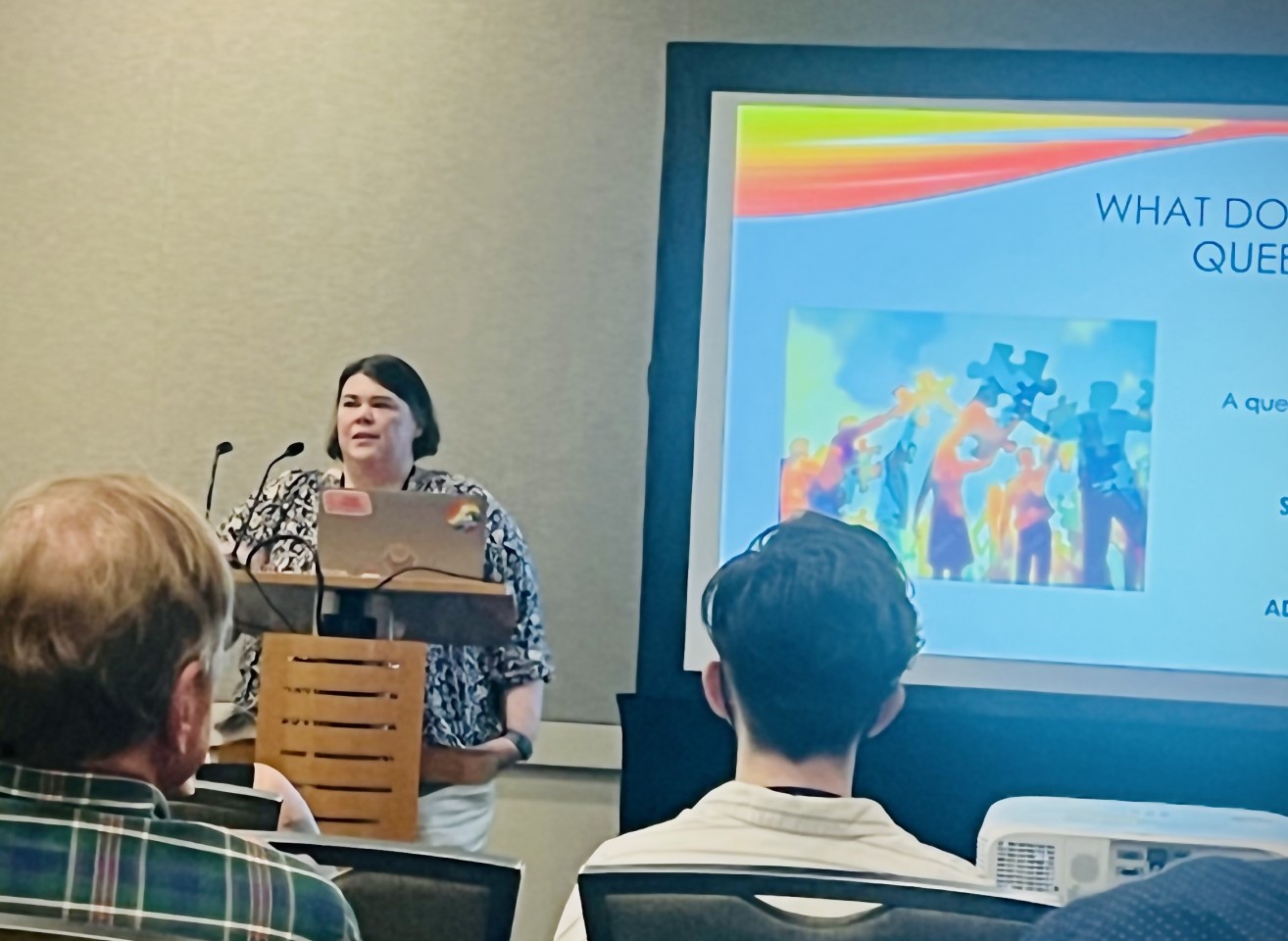
Dr. Skerven presenting her Fellows talk.
|
Congratulations to WPA board member, Advocacy Cabinet Director, DEI committee member, and APA Council of Representatives member, Dr. Kim Skerven, who was named an APA Division 44 – Society for the Psychology of Sexual Orientation and Gender Diversity Fellow! Click here to read more. Excellent work, Dr. Skerven! |
|
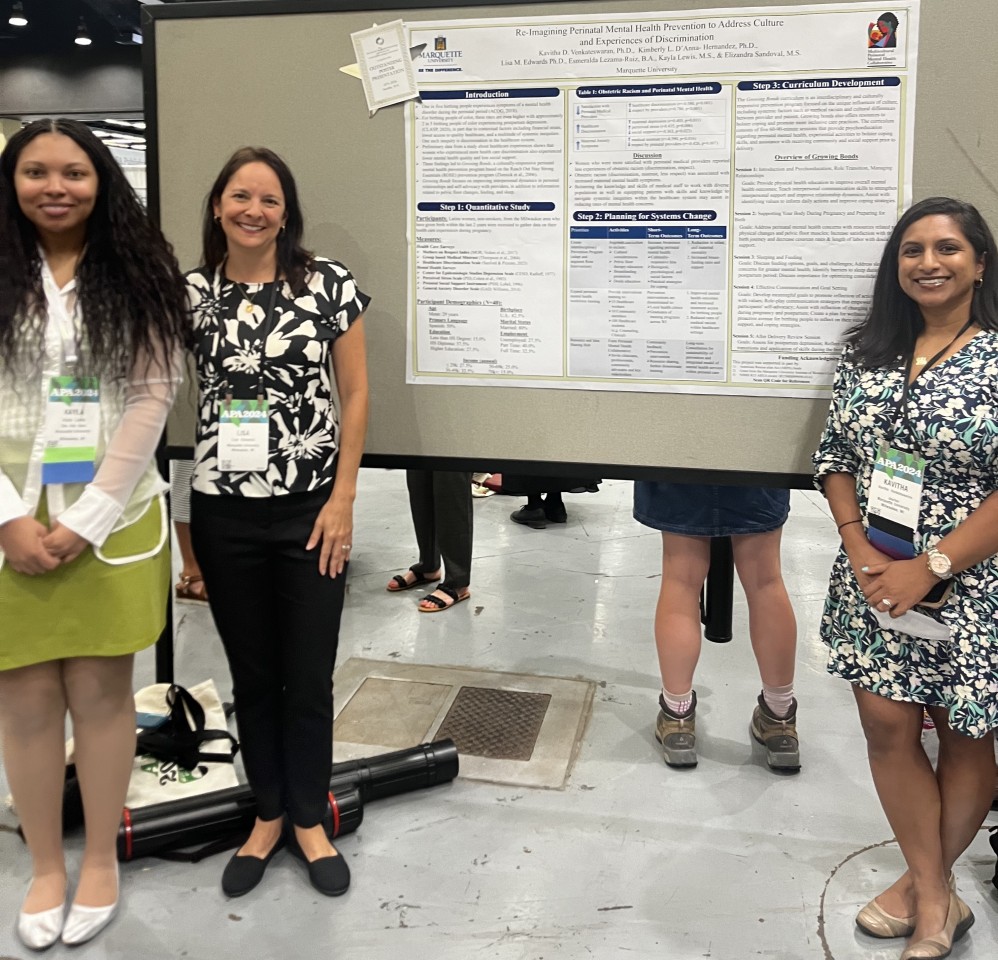
WPA board member and DEI committee chair, Dr. Kavitha Venkateswaran, along with her colleagues, Dr. Lisa Edwards, and doctoral student Kayla Lewis, all from Marquette University’s Department of Counselor Education and Counseling Psychology, were recognized for their Outstanding Poster Presentation by APA’s Division 38 - Society for Health Psychology, for their APA poster presentation titled: Re-Imagining Perinatal Mental Health Prevention to Address Culture and Experiences of Discrimination. Well done! |
Pictured left to right: Kayla Lewis, Doctoral Student, Dr. Lisa Edwards, and Dr. Kavitha Venkateswaran. |
|
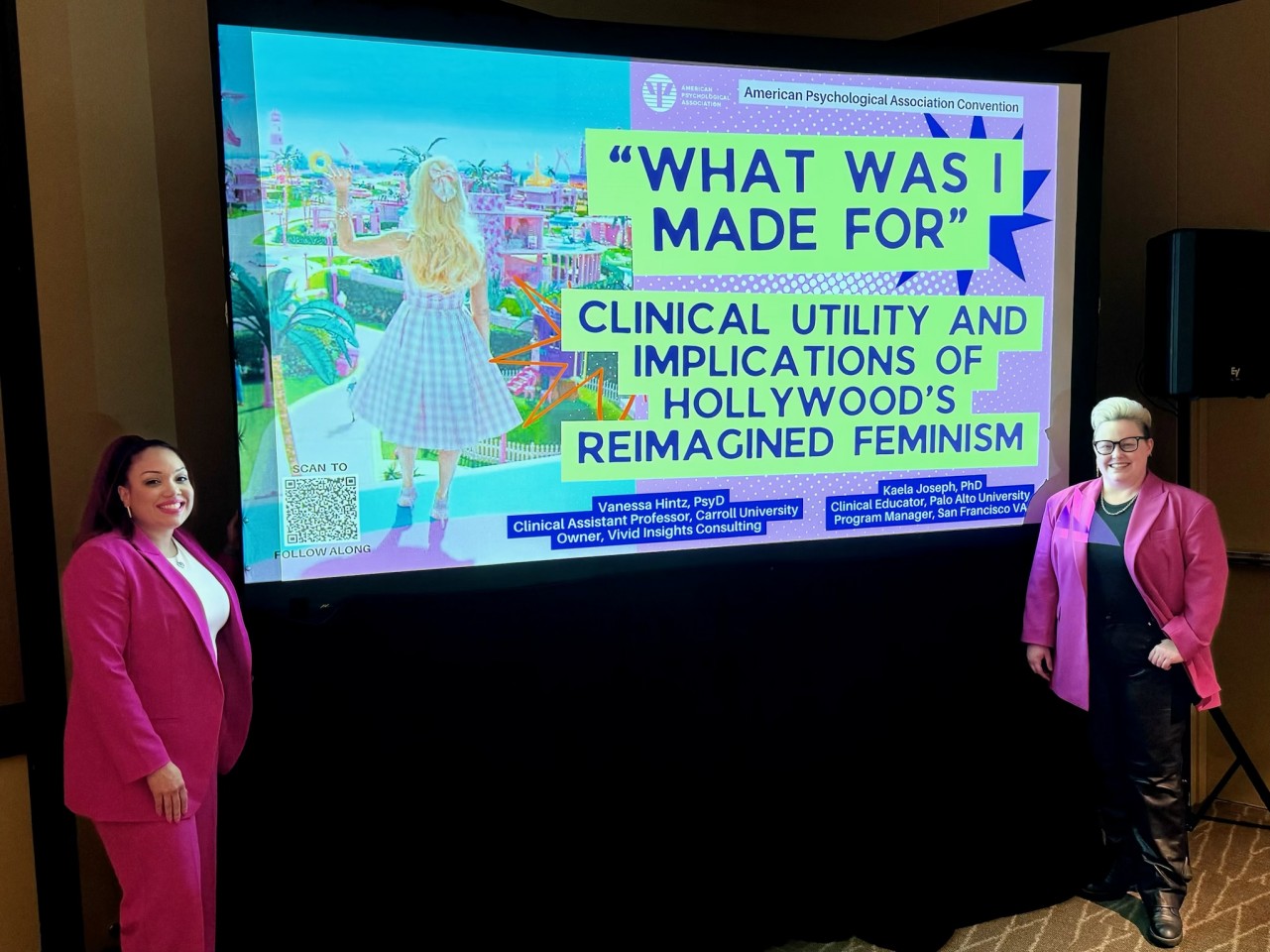
Pictured left to right: Dr. Vanessa Hintz |
WPA Vice President, Dr. Vanessa Hintz, and her colleague, Dr. Kaela Joseph, presented their talk: “What I Was Made For” – Clinical Utility and Implications of Hollywood’s Reimagined Feminism, at APA, sponsored by Division 35 - Society for the Psychology of Women. Brava!
|
Takeaways and Moving Forward
| As an organization, WPA continues to explore innovative ways to meet the needs of our membership, but equally as important is expanding our membership to reflect the demographics of psychologists within our state. Members of the DEI committee, Kim Skerven and Kavitha Venkateswaran, attended a session at the recent APA annual convention focused on creating a more welcoming environment and attracting a more diverse membership within state psychological associations. Increasing representation and providing an inclusive and just climate is absolutely crucial to both address the historical injustices of our field and to ensure that our state organization is truly representing and enacting the best interests of our state’s psychologists. During this session, we learned about the trends and challenges facing many state associations, including declining membership, and the imperative to identify new initiatives and benefits that serve members from historically marginalized groups. We heard best practices that other associations are implementing in order to diversify their membership and to advocate for marginalized groups within the psychological profession, including making sure values of diversity, equity, and inclusion are structurally and systemically embedded into all aspects of the organization. We have known and continue to realize we have work to do within WPA. The DEI committee will be taking the ideas gained in this presentation to continue to advocate for climate improvements and structural changes that will hopefully lead to a just and welcoming environment for all psychologists within Wisconsin.
|
Resolutions and Updates
|
|
APA recently approved several resolutions on critical social issues, including the role of psychology in AI; Supporting Psychologists' Education and Research about, and Activism against Violations of Girls' and Women's Human Rights Globally; a Policy Statement on Immigrant Health; a call for a ceasefire in Gaza, and a Statement on Individual, Collective, and Intergenerational Trauma Recovery: Considering the Restorative Roles of Restitution and Reparations. Click here for for full details.
For continued DEI related updates and resources from APA, visit the link below: |

Listen and Learn
 |
The Liberation Now Podcast From the Liberation Now Podcast website – Find them online at Liberation Now Podcast (libsyn.com) or your favorite podcast listening app. |
Statement on Racism, Violence, and Discrimination
 The mission statement of the Wisconsin Psychological Association (WPA) states that we “address concerns of our communities by responding as a profession to psychological and social needs of Wisconsin citizens.” The recent murder of George Floyd, among others, exposes what American Psychological Association (APA) President, Dr. Sandra Shullman, has called a “racism pandemic” in this country. This pandemic is marked by structural inequities that have systematically oppressed Black Americans.
As human beings, we share anguish, fear, and anger as we reflect on the deep pain and injustice created and maintained by racist policies and practices. As psychologists, our science affirms that racism threatens the physical well-being, psychological well-being, and the lives of people of color. We are called to reflect. We are called to act.
WPA encourages all members to reflect on the role of privilege in society, including how one’s cultural views--of self and others--influence our work as psychologists. We encourage members to join our colleagues at APA and other organizations to take a stand in incontrovertibly condemning acts of violence against people of color. We urge each of our members to take action in advocacy and supportive efforts aimed at eradicating all forms of racism, violence, and discrimination. For the majority of our members who identify as White, continuing to challenge our awareness of other cultures and potential biases is paramount to becoming effective allies.
WPA stands firmly against all forms of racism, discrimination, and hate. WPA is committed to challenging systemic injustice and will take a stand in the face of oppression and inequity. We add our voice to those proclaiming that black lives matter, those seeking to facilitate change, and those promoting education and healing. To support these aims, WPA commits to:
- Make clear and sustained efforts to increase association membership and leadership from historically marginalized groups;
- Make clear and sustained efforts to learn from Black community leaders; and
- Offer continuing education opportunities in the areas of equity and social justice.
We support the efforts of all who are working to eliminate structural racism and promote social justice.
